
Hats for Large Heads: What Actually Matters
A cap that closes on the last snap has technically gone around your head.
That does not mean it fits.
It may still perch too high, pull at the temples or leave you with a rear opening that looks as though it is doing most of the work. If that sounds familiar, shopping for another “XL” is not much of a plan.
Start with a published size range that includes your measured circumference. Then check crown room, opening shape and how the adjustment works. Those are separate questions, and a large-head label rarely answers all of them.
The goal is a hat you actually like wearing. Merely getting it onto your head is a low bar.
Start With Centimeters, Not XL
Measure where the hat’s sweatband will actually sit, with your usual hat-wearing hairstyle. Take the tape off and repeat the measurement rather than adjusting it until you get the number you expected.
If you need the full procedure, use our How to Measure Your Head for a Hat guide.
Keep that circumference as your shopping reference. A size label is useful only when it leads back to a maker’s chart.
One company’s XL may cover you. Another company’s XL may stop short. A general brand chart can also show sizes that a particular model does not offer.
For larger measurements, that distinction becomes especially annoying. You find the right number in the guide, open the product page and discover that the hat stops two sizes earlier.
Check the actual model’s selectable sizes as well as the chart.
Is 63 cm the Point Where a Head Becomes “Large”?
There is no single threshold that makes every hat retailer organize its stock the same way.
For a practical example, a shopper measuring 63 cm needs a model whose published range includes 63 cm. Whether the seller calls that XL, XXL or something else is secondary.
Do not turn a useful shopping filter into an anatomical category. A longer 63 cm head and a rounder 63 cm head can still need different openings.
Our Hat Size Guide explains the size systems without making the letter label do more than it can.
Check Crown Room Separately
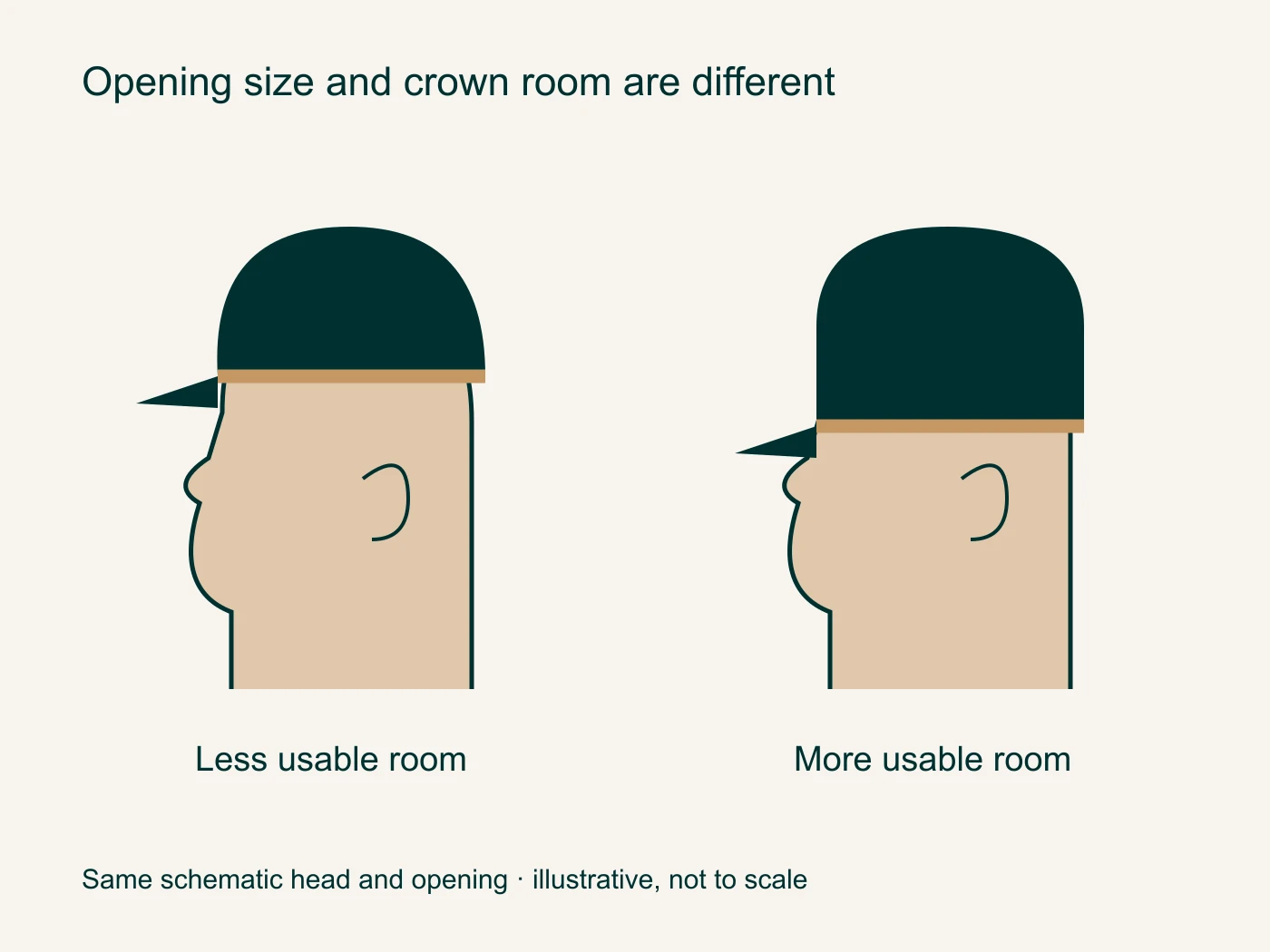
A hat can fit around your head and still sit awkwardly high.
That is where usable crown depth matters. You need enough interior room for the hat to reach its intended wearing position without the top or shape of the crown getting in the way.
A larger circumference does not prove that the crown has become deeper. Nor does a tall-looking exterior guarantee the space inside will work for your head.
New Era’s 59FIFTY silhouette guide makes the distinction visible: the original fitted cap has a tall, broad full crown, while the Low Profile version uses a contoured crown. Those descriptions explain different constructions within one family. They do not promise that one fits every larger head.
If your cap’s band feels reasonable but the cap keeps perching, investigate the profile before ordering a looser band.
If it settles farther down than you want, more depth is not an upgrade.
Our crown-depth guide explains what to compare, including why crown height and usable depth should not be treated as interchangeable measurements.
Look at Head Shape and Pressure
“Large head” tells you very little about where a hat will press.
A relatively long head may meet the front and back of a rounder hat opening before the sides make useful contact. A broader head may encounter the reverse problem in a narrower opening.
That can leave you with the particularly irritating combination of tight and loose.
Going up may relieve one pressure point while creating more spare room elsewhere. It is worth checking another opening shape, especially with a structured felt or straw hat.
Describe the actual problem:
- Tight all around the sweatband
- Pressure at the forehead and back, with room at the sides
- Pressure at the sides, with gaps elsewhere
- Comfortable band, but the crown stops too high
Those observations help a seller distinguish a likely circumference problem from a possible shape or depth problem. They do not diagnose your head from the sofa.
For the detailed explanation, read Head Shapes for Hats and why the right size can still fit wrong.
Treat Adjustment as a Limited Range
Adjustable is useful. Universal is a much bigger claim.
A strap, snap closure or internal adjuster changes the opening within the limits of that hat’s design. You still need to know the intended range and whether the closure stays properly engaged at your setting.
If the seller provides only “one size,” ask for the intended head-circumference range. Do not assume an adjustable cap will reach your measurement because a product photograph shows a long strap.
There is also a difference between a cap that can just fasten and a cap designed to sit well at your size. Check the crown and the rear opening with the adjustment secured. An opening pulled unusually wide is a reason to look for a more suitable model, not proof that you found a clever workaround.
Stretch-Fit Still Has Limits
A stretchy band may cover several measurements, but it is still intended to operate within a range.
Use the exact model’s chart. Do not assume a familiar S/M or L/XL label will mean the same thing in another style. If you are near the upper end and the band feels persistently tight, the fact that it stretches is not much comfort.
You do not earn a better fit by tolerating more elastic.
Where to Start Looking
The useful starting points differ by hat type. The examples below demonstrate published options and what to verify; they are not a tested ranking of the best hats for every large head.
| Hat type | Useful starting evidence | What it does not prove |
|---|---|---|
| Fitted baseball cap | Exact numbered size plus silhouette | Internal crown depth or personal fit |
| Adjustable cap | Published circumference range | Universal fit or adequate crown room |
| Newsboy cap | Exact model’s size run | Preferred fabric is in stock |
| Structured felt hat | Size chart and any stated oval shape | All models from the brand fit alike |
| Bucket or sun hat | Size options and closure range | Depth, UPF or coverage without further evidence |
Baseball Caps: Look for the Full Size and Profile
For a fitted cap, search the actual size you need, then check the precise silhouette. A full-crown model and a low-profile version are different shopping propositions even when the size label matches.
For adjustable styles, specialist retailers can make the size search easier. Big Head Caps’ structured-cap collection publishes a stated fit range for its adjustable six-panel caps. Use the individual listing and its chart to confirm that the construction and closure suit you.
A specialist name is a lead, not a fit guarantee. It cannot tell you how a particular cap will sit above your ears.
Newsboy Caps: Large Sizes Can Come With a Lot of Crown
Two examples already covered in NESH’s newsboy guide are worth investigating.
Hanna Hats’ Eight Piece Tweed lists sizes through XXXL at 66–67 cm. Sterkowski’s Peaky Harris Tweed shows a size run through 65 cm.
Those published ranges give some larger-head shoppers somewhere concrete to start. They do not establish stock in your preferred fabric or a personal fit.
Both are full-looking traditional newsboy styles. If you want a restrained cap, do not buy a voluminous eight-piece merely because it is the first one with your number on the label.
A larger head does not oblige you to wear a larger visual statement.
Our Best Newsboy Caps for Men compares the silhouettes as well as the sizing. Keep both parts of that decision.
Fedoras and Other Structured Hats: Ask More of the Listing
Look for an exact circumference or a numbered size tied to a chart, then investigate the opening shape.
Do not assume every hat from a brand shares the same oval fit. A long-oval description belongs to the model that actually carries it.
If the maker publishes external crown height, use that as a description of the hat. It is not a measured promise of interior depth. If shape or depth has caused repeated trouble, a specialist fitting can be more productive than another order based on a front-view product photograph.
For an expensive structured hat, a useful exchange policy matters. You may need to compare the real thing with your head, which remains stubbornly three-dimensional.
Bucket and Sun Hats: Check the Whole Fit
A broad brim does not establish a large opening. An internal drawcord does not establish adequate depth.
Look for actual size options and the intended adjustment range. Then judge whether the hat sits comfortably and stays at the intended position.
If you want sun-protection claims, check those separately on the exact product. A large size and a wide brim do not, by themselves, establish a tested UPF rating or complete coverage.
Check the Exact Size Before You Buy
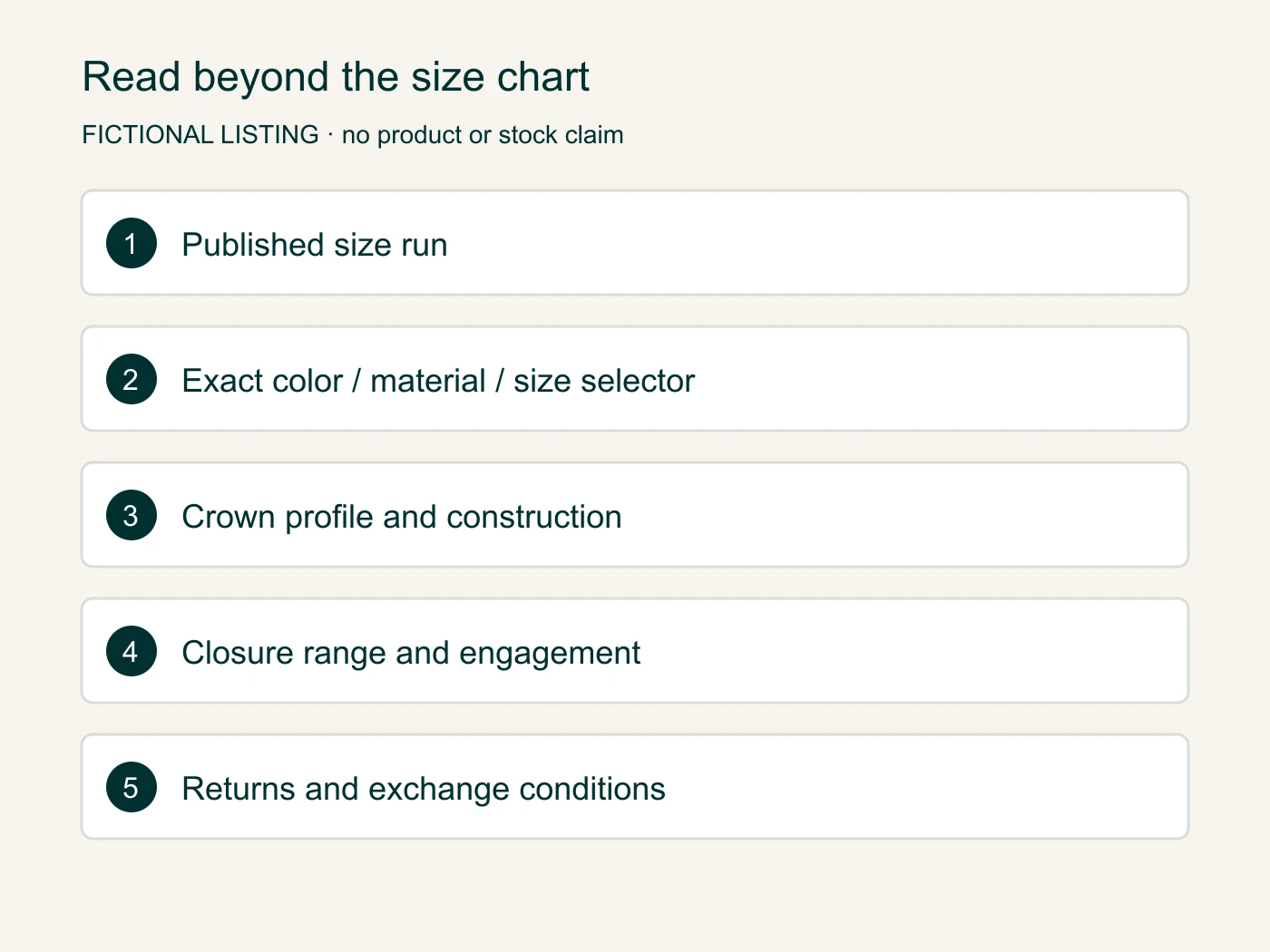
Save yourself a round trip by checking these details while you still have the product page open.
Circumference: Does the exact model’s chart include your measurement?
Size selection: Is that size offered in this model, rather than appearing only in the general chart?
Crown: Are there side views, profile descriptions or useful construction details? Is the published measurement external height or interior depth?
Shape: Does the maker state an oval fit? If not, treat it as unknown.
Adjustment: Is the intended range published, and can the closure remain securely engaged at your setting?
Variant: Is the relevant size available in the actual color and material you want?
Returns: Can you try the hat indoors, and what would an exchange cost?
If a key detail is missing, ask one focused question. “My head measures 64 cm and shallow caps tend to perch; what is this model’s intended range and profile?” is much easier to answer than “Will this fit a big head?”
If the seller cannot answer, you have learned something about the buying risk.
Questions About Large-Head Fit
Does a Large Head Need a Wide Brim?
No. Brim width is a style and use decision, separate from whether the opening fits.
A wider brim can change the proportions of the whole hat, but there is no requirement to “balance” your head with the largest brim available. Choose a silhouette that works with your clothes and feels like something you would wear.
Can I Size Up to Get More Depth?
Sometimes a larger size changes more than the opening, but you cannot assume it provides the crown room you need.
If the current band is already comfortable, investigate another profile before increasing circumference. A loose hat that still perches is not much progress.
Should I Stretch an Ordinary Hat Instead?
Do not make stretching the purchase plan. Alteration depends on the material, construction and amount of change required.
Ask the maker or a hatter about the exact hat. A model sold in your measurement is a more straightforward starting point than a smaller one bought with an ambitious rescue mission attached.
Buy for Your Measurement, Then Choose the Hat
Filter by the number first. Check the crown and shape second. Then choose something you actually want to wear.
That order keeps you from falling for a hat that cannot fit, without reducing the whole shopping trip to “anything in XXL.”
Enough room is the minimum. You still get to have taste.
One Comment