Hat Crown Depth: Why It Matters for Fit
A hat can fit perfectly well around your head and still seem determined to sit somewhere you did not ask it to.
Too high. Too low. Perched on top. Dropping farther down than you expected.
At that point, another circumference measurement may not tell you much.
The problem may be crown depth.
Hat size mostly tells you what happens around your head. Crown depth helps determine what happens above it — and how far down the hat can actually settle when you put it on.
That difference sounds small until you wear two hats in the same size and one feels completely natural while the other seems to be balancing on your head.
Quick answer
Crown depth is the amount of usable space inside the crown of a hat.
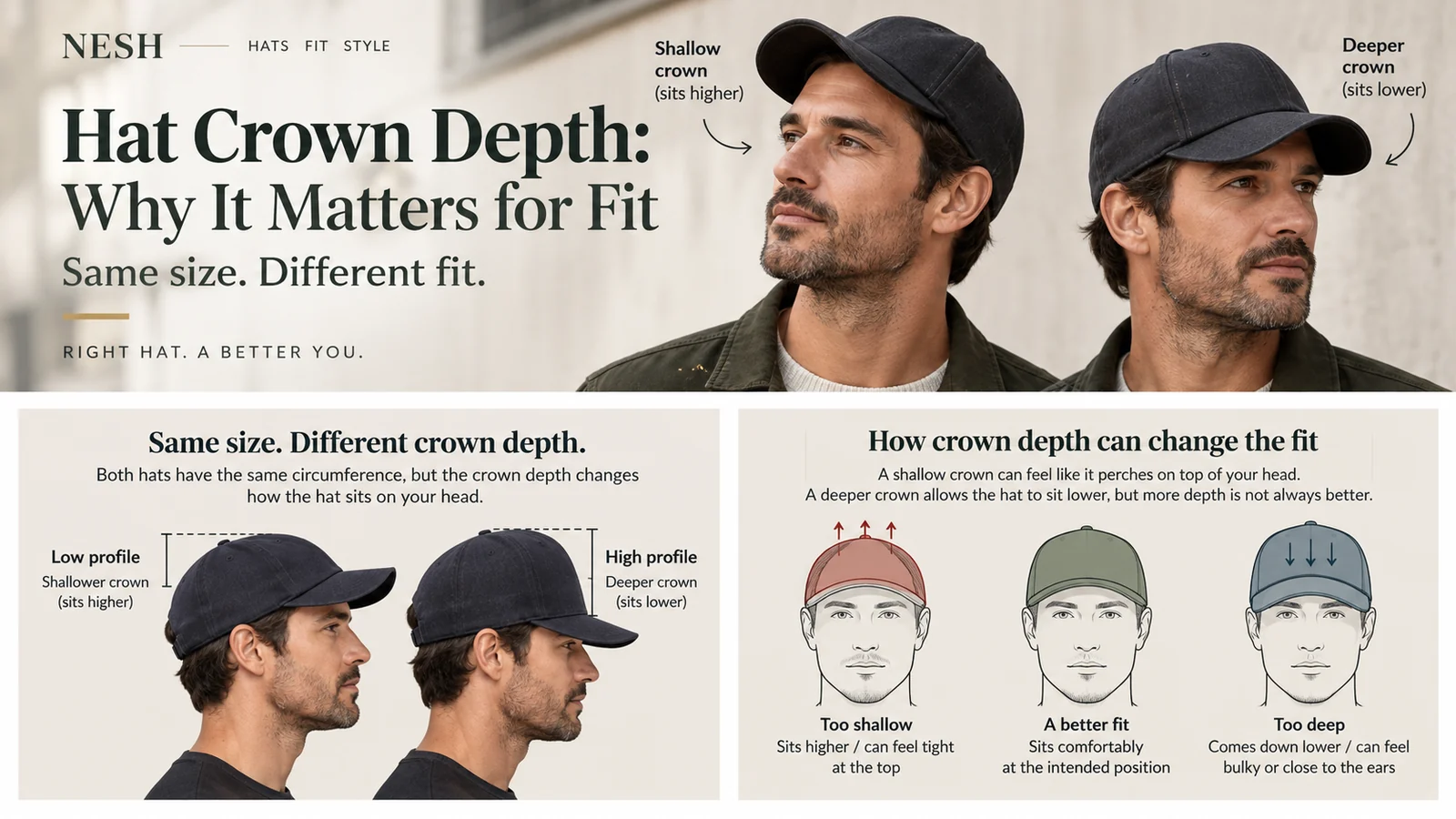
A deeper crown generally allows the hat to sit farther down on the head. A shallower crown tends to sit higher.
But deeper is not automatically better.
The right depth depends on the hat, your head, your hair and where you actually want the hat to sit.
It is also worth knowing that hat companies do not use terms such as low profile, high crown, deep fit, full crown and crown depth in one perfectly standardized way. They can describe related characteristics, but they are not interchangeable measurements.
Use manufacturer terminology as information about that particular hat — not as a universal sizing system.
Hat size and crown depth solve different problems
The easiest way to separate them is this:
Circumference asks: does the hat fit around my head?
Crown depth asks: can the hat sit down on my head the way it is supposed to?
You can get the first one right and the second one wrong.
Imagine a fitted cap that matches your circumference closely but stops noticeably higher than you want.
The sweatband does not feel especially tight.
Going up a size may make the band looser, but it does not necessarily create the crown shape or depth you were missing.
That is one of the reasons a hat can technically be the correct size and still fit wrong.
What crown depth actually means
The crown is the part of the hat above the sweatband.
Crown depth is concerned with the usable interior space that your head occupies.
That is slightly different from crown height, which usually describes how tall the crown is externally.
They are related, but they are not necessarily the same thing.
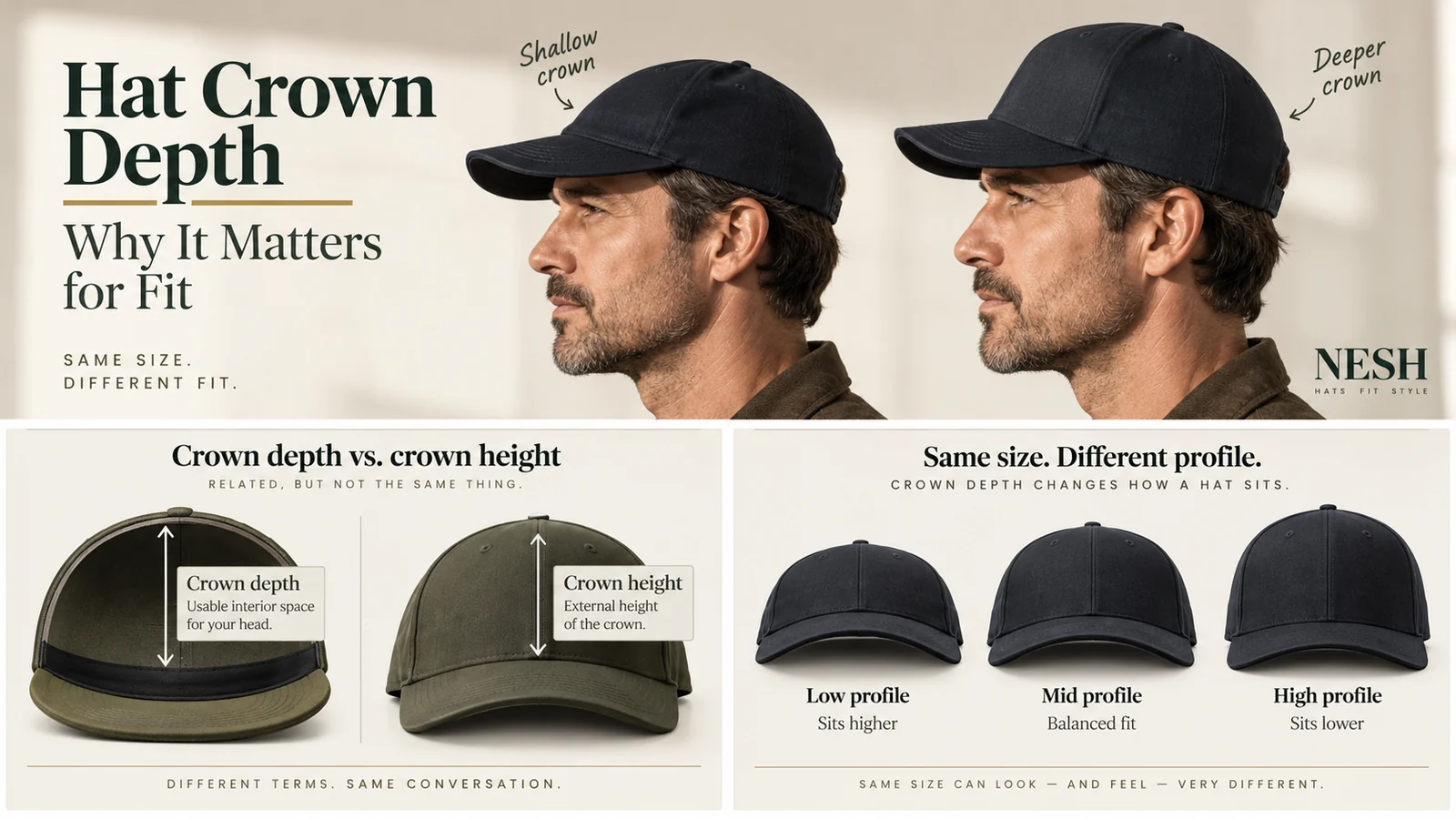
A hat can have a visibly tall crown because of its shape or construction without all of that external height translating directly into extra usable depth around your head.
Manufacturers may describe the same general area using terms such as low profile, mid profile, high profile, full crown, deep fit, crown height or crown depth.
Those labels are useful within a brand or product line.
They are much less useful as universal measurements across the entire hat industry.
Richardson separates several cap shapes into Low Pro, Mid Pro, Full Pro and Hi Pro constructions. New Era distinguishes its standard 59FIFTY Full Crown from its lower-profile version. AHEAD describes some fits as both wider in circumference and deeper through the crown.
The useful lesson is not that one company’s terminology is the correct system.
It is that brands themselves treat crown dimensions as a fit variable separate from circumference.
What a crown that is too shallow can feel like
A shallow crown does not always feel obviously small.
That is what makes it confusing.
The hat may seem to perch on top of your head. You may find yourself repeatedly pulling it down. The sweatband may feel reasonable while the hat still seems undersized, or the silhouette may simply sit higher than you expected.
With a baseball cap, you might just think:
Why won’t this thing sit down properly?
With a structured brimmed hat, the effect can be more obvious because the crown reaches a point where it cannot comfortably settle any farther.
None of those clues proves crown depth is the problem.
But if the circumference feels reasonable and the hat simply refuses to sit where you want it, depth becomes worth investigating.
What a crown that is deeper than you want can feel like
More room is not automatically better.
A crown can also come farther down than you want, feel visually heavy, or put the hat closer to your ears than you prefer even though the sweatband itself fits.
That last point needs some care.
There is no universal rule saying every hat should sit a certain distance above the ears.
Different hats are designed to sit differently, and people wear them differently.
The NESH rule remains the same:
Judge the hat at the position where its sweatband is actually intended to sit.
Do not force every style onto one imaginary eyebrow-and-ear line.
Why going up a size may not fix a shallow crown
Suppose the hat feels high on your head.
The natural reaction is:
Maybe I need a larger size.
Sometimes you do.
But increasing circumference and increasing crown depth are not the same adjustment.
A larger hat may give you more room around the sweatband while leaving the basic crown profile largely unchanged.
Now the hat is loose and still not sitting quite the way you wanted.
Before changing sizes, ask:
Is the hat actually tight around my head, or does it simply stop too high?
If the band itself feels uniformly tight, size deserves attention.
If the band feels reasonable but the hat seems perched, crown depth or crown shape may be more relevant.
Head shape can change how the crown feels
Even crown depth does not work in isolation.
Two people with the same circumference may not use the interior space of the same crown in exactly the same way.
A relatively longer head, a rounder head, hairstyle and the shape of the hat opening can all change where contact happens first.
That is why head shape and crown depth can overlap.
If the hat presses front and back before settling comfortably, opening shape may be part of the problem.
If it has room around the band but simply cannot come down far enough, depth becomes a stronger suspect.
And sometimes both are involved.
Hat fit is annoyingly good at refusing to fit into one variable at a time.
Structured hats make crown depth easier to notice
A very soft hat has some ability to adapt.
A firmly structured crown has much less.
Compare a soft knit cap with an unstructured baseball cap, a structured fitted cap, a blocked fedora or a stiff western hat.
As structure increases, the hat increasingly brings its own geometry to the negotiation.
Your head does not simply push everything into the right shape.
That is why two structured hats with similar circumference measurements can feel dramatically different.
The band may be the same size.
The space above it is not.
Low profile does not automatically mean shallow
This is one of the terminology traps worth avoiding.
A manufacturer may call a cap low profile because of the overall crown shape and silhouette.
Another may describe a fit as deep because of how far down it is designed to sit.
Another may publish an actual crown-height measurement.
Those pieces of information are related, but they do not give you a universal conversion chart.
You cannot safely say:
Low profile always means shallow.
Or:
A 12 cm crown is always shallow and a 14 cm crown is always deep.
There is too much variation in hat type, construction, measuring method and intended wearing position.
Manufacturer specifications are usually most useful when comparing hats within the same brand or product family.
How to tell whether the problem is size or crown depth
You do not need a complicated measurement system.
Start with what the hat is actually doing.
| What you notice | What it may suggest |
|---|---|
| Tight all the way around | Circumference may be too small |
| Loose all the way around | Circumference may be too large |
| Band feels reasonable, but hat sits unusually high | Crown depth or profile may be involved |
| Hat comes farther down than you want | Crown may be deeper than you prefer |
| Pressure at specific front/back or side points | Head shape and opening shape may be involved |
| Hat rocks despite the band seeming correct | Size, shape, depth or construction may all contribute |
| Same size works in one model but not another | Model geometry, including crown depth, may differ |
Again, these are clues.
Not diagnoses.
The point is to identify which variable deserves attention before you start ordering random sizes in both directions.
How to compare crown depth when shopping online
Unfortunately, many product pages do not publish a simple internal crown-depth measurement.
You can still gather useful clues.
Look for the manufacturer’s profile terminology
If a company offers the same family in low, mid, full or high profiles, that is useful comparative information.
Treat it as brand-specific, not universal.
Compare models within the same brand
This is usually more useful than comparing a “high crown” from Brand A with a “high crown” from Brand B.
The labels are more likely to mean something consistent inside one manufacturer’s own range.
Look at the hat from the side
Front-facing product photographs can hide crown depth surprisingly well.
Side and three-quarter views usually tell you more about how high or low the crown is designed to sit.
Photography cannot tell you exactly how the hat will fit your head.
But it can help you compare silhouettes.
Read fit descriptions carefully
Phrases such as deeper fit, lower profile, full crown, high crown, sits closer to the head or roomier crown can provide useful clues when they come from the manufacturer.
Just do not convert marketing language into a precise measurement the brand never provided.
Use a hat you already own as a reference
If you have a hat that fits particularly well, note more than the size label.
Look at the model, crown profile, structure, how far down it sits and how much room you feel above your head.
That gives you a much better reference than simply saying:
I wear a medium.
Can you measure crown depth yourself?
Yes — particularly if you are comparing two hats you already own.
The important part is consistency.
Measure both hats in the same way, from comparable points, without forcing or deforming the crown.
If one fits noticeably deeper than the other, that comparison may help explain what you are feeling.
What the number does not give you is a universal crown-depth size chart.
A measurement that feels deep in one style may not mean the same thing in another.
Treat home measurements as comparison data, not as a new sizing system.
What to do if the crown feels wrong
Start with the basics.
1. Confirm the circumference
Use a repeatable head measurement and the specific manufacturer’s current size chart.
If you need to start there, use our Hat Size Guide and head-measuring guide.
2. Decide whether the problem is around your head or above it
Is the sweatband itself too tight?
Or does the band feel fine while the crown sits strangely?
That distinction can save a lot of guesswork.
3. Check the model’s profile or crown description
If the manufacturer publishes low/mid/high-profile information or mentions a deeper or fuller crown, compare it with other models in the same range.
4. Try another model before assuming another size will solve it
Sometimes the answer to a poor-fitting medium is not a large.
It is a different medium.
That applies to head shape, crown depth and overall construction.
5. Judge the actual wearing position
Do not force the hat lower just because you think every hat is supposed to sit in the same place.
And do not wear it higher simply because that is where a shallow crown stops.
The useful question is whether the hat can sit securely and comfortably in the position intended for that style and for the way you want to wear it.
Deeper is not better. Shallower is not better.
A deeper crown is useful when you need or prefer more depth.
A shallower crown is useful when that profile suits your head and the way you want the hat to sit.
Neither is an upgrade.
They are fit characteristics.
The goal is not to buy the deepest crown available.
It is to find the hat whose circumference, shape and crown depth work together.
The useful way to think about crown depth
When a hat feels wrong, separate the questions.
Does it fit around my head?
Does the opening shape suit my head?
Can the crown settle to the position I want?
If the first answer is yes and the third is no, changing size may not be the solution.
That is where crown depth becomes useful.
Not as another complicated number to memorize.
As one more way to understand why a hat that looks right on the size chart can still feel completely wrong once you put it on.
Where to go next
If your first problem is the number on the label, start with our Hat Size Guide.
If the number looks correct but the hat still pinches, gaps or shifts strangely, read Why a Hat Can Be the Right Size but Still Fit Wrong.
And if the pressure seems concentrated at the sides or front and back, Head Shapes for Hats will help you separate a shape problem from a simple sizing problem.