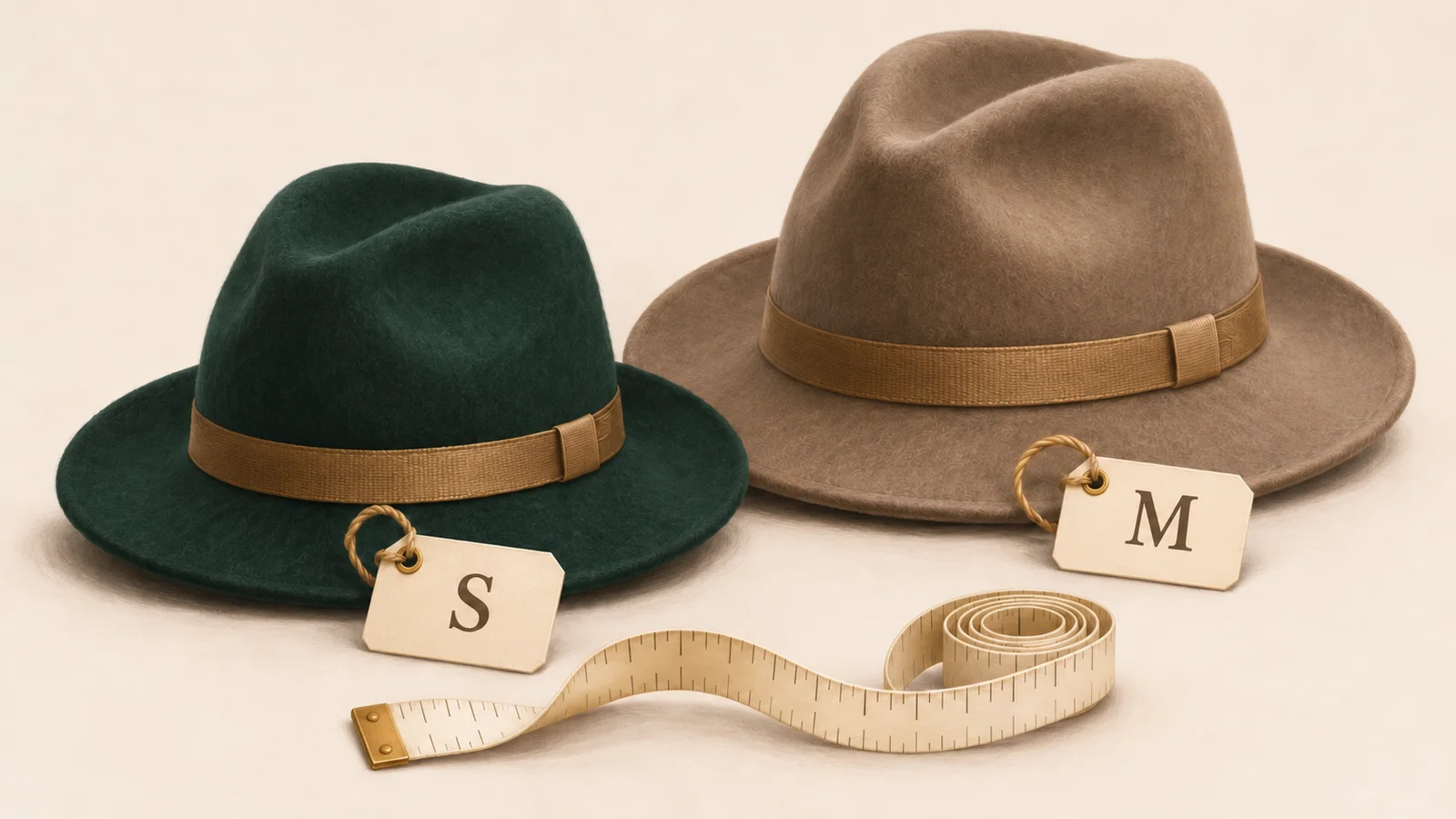
What to Do When You Are Between Hat Sizes
One size feels like a negotiation with your forehead. The next one slides down when you look at your shoes.
Being between hat sizes is frustrating because the usual advice—“just size up”—sounds more complete than it is.
For many fixed-size hats, the larger size is the sensible starting point when the maker recommends it. But it needs to sit properly before you start adding padding. A slightly loose sweatband can sometimes be adjusted. The wrong crown shape is a different problem.
Here is how to make the choice without buying a smaller hat and hoping your head eventually loses the argument.
Check Whether You Are Really Between Sizes
Start with a fresh measurement, taken where that hat’s sweatband will actually sit. Wear your hair as you expect to wear it under the hat. Keep the tape comfortably snug, without pulling it into your skin.
Take it off and measure again. If you get noticeably different results, sort out the tape position and tension before making a buying decision. Our head-measuring guide walks through this without turning it into a science project.
Then use the chart for the exact hat or product family. A general chart is a fallback when the brand provides nothing more specific.
An M in your favorite cap does not establish your size in a different maker’s fedora. Even a familiar fractional size needs the correct regional chart. Our Hat Size Guide explains the labels; the seller’s chart makes the purchase decision.
Keep the Measurement You Actually Got
Suppose repeated measurements put you at 58.5 cm. Do not quietly turn that into 58 cm because the smaller size is on sale.
If a particular maker offers 58 and 59 cm and directs between-size customers upward, 59 cm is the starting point. That is an example of applying that maker’s rule—not a universal conversion.
Also distinguish a single size from a size range. A stretch-fit S/M might cover a band of measurements. If your circumference falls within two overlapping ranges, you have a choice between two constructions under tension, not simply two rigid openings.
Choose by Construction, Not a Blanket Rule
Stetson’s fit guide recommends moving up when you fall between sizes and using padding to refine the fit. Brixton also recommends the larger size, while noting that its general chart can vary by style.
That makes sizing up a well-supported starting point for those brands. It does not make it the answer for every hat.
| Hat construction | Starting decision | Reassess if |
|---|---|---|
| Fixed-size felt or straw | Follow the exact maker’s between-size rule; often start larger | It sinks, rocks or needs substantial padding |
| Stretch-fit | Use the specific style’s range and advice | Elastic causes persistent pressure |
| Adjustable | Confirm the intended range, then adjust securely | Opening fits but crown still perches |
| Soft newsboy or flat cap | Check band construction and maker guidance | Soft crown disguises a firm or unsuitable band |
Fixed-Size Felt and Straw Hats
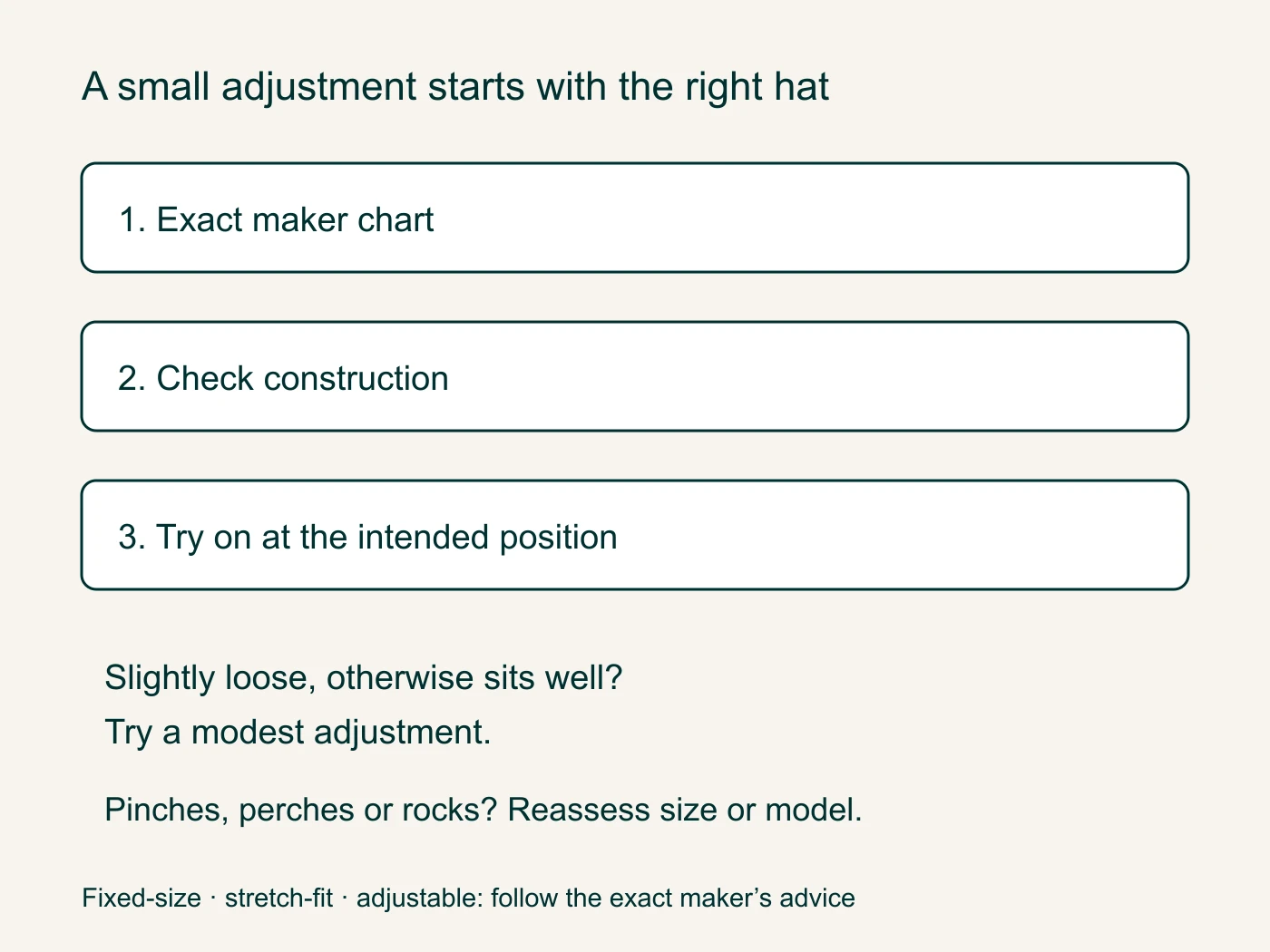
If the maker recommends the next size, start there. You want a hat that sits securely without persistent pressure, with only a modest adjustment needed if it feels slightly loose.
Do not buy the smaller one on the assumption that felt or straw will obligingly stretch. Construction, sweatbands and the particular hat all matter. Professional alteration may be possible, but it is a poor substitute for buying an appropriate size in the first place.
Stretch-Fit Caps
Read the exact style’s range and instructions. Stretch is part of the fit mechanism, not permission to ignore the size chart.
If both sizes cover your measurement, ask the seller how that model is intended to fit. The useful question is whether it holds securely without distracting pressure—not whether you can physically pull it onto your head.
A range printed on a page cannot tell you how you will tolerate the elastic. Try both where practical, keeping the hats in returnable condition.
Adjustable Caps and Brimmed Hats
A rear strap or internal adjuster can bridge a small circumference difference. Check that the hat’s published range actually includes you, then judge the fit with the closure properly secured.
An adjuster tightens or loosens the opening. It does not necessarily give you more usable room above it.
If the cap still perches high with a comfortable band, you may need another crown profile. Pulling the strap harder is unlikely to improve that conversation.
Soft Caps, Including Newsboys
A soft crown does not automatically mean a stretchy sweatband. Check how the band is made and how the maker handles between-size orders.
Some companies want you to ask. Hanna Hats’ current Eight Piece sizing guidance, for example, directs between-size customers to its team for advice. That is more useful than applying another brand’s rule to an entirely different cap.
Test the Larger Size Before Adjusting It
Try the hat indoors with the tags attached, following the seller’s return conditions.
Set it at its intended wearing position. Then check three things.
Where is the pressure? Tight all around suggests a different issue from pressure at the forehead and back with spare room at the sides. Uneven contact can point toward a shape mismatch.
Where does the hat stop? If the band feels reasonable but the crown prevents the hat from settling, increasing circumference may leave you with a loose opening and the same perched feeling.
Does it stay put during ordinary movement? Look down, turn your head and walk around. You should not need to keep rescuing it from your eyebrows.
These are practical checks, not a timed certification. There is no magic “wear it for ten minutes” rule that proves a fit is right.
If the larger size sits naturally and is just a little loose, an adjustment may make sense. If it sinks, rocks or needs a substantial amount of filler to stay in place, question the model or size before reaching for more foam.
Use a Size Reducer for a Small Fit Correction
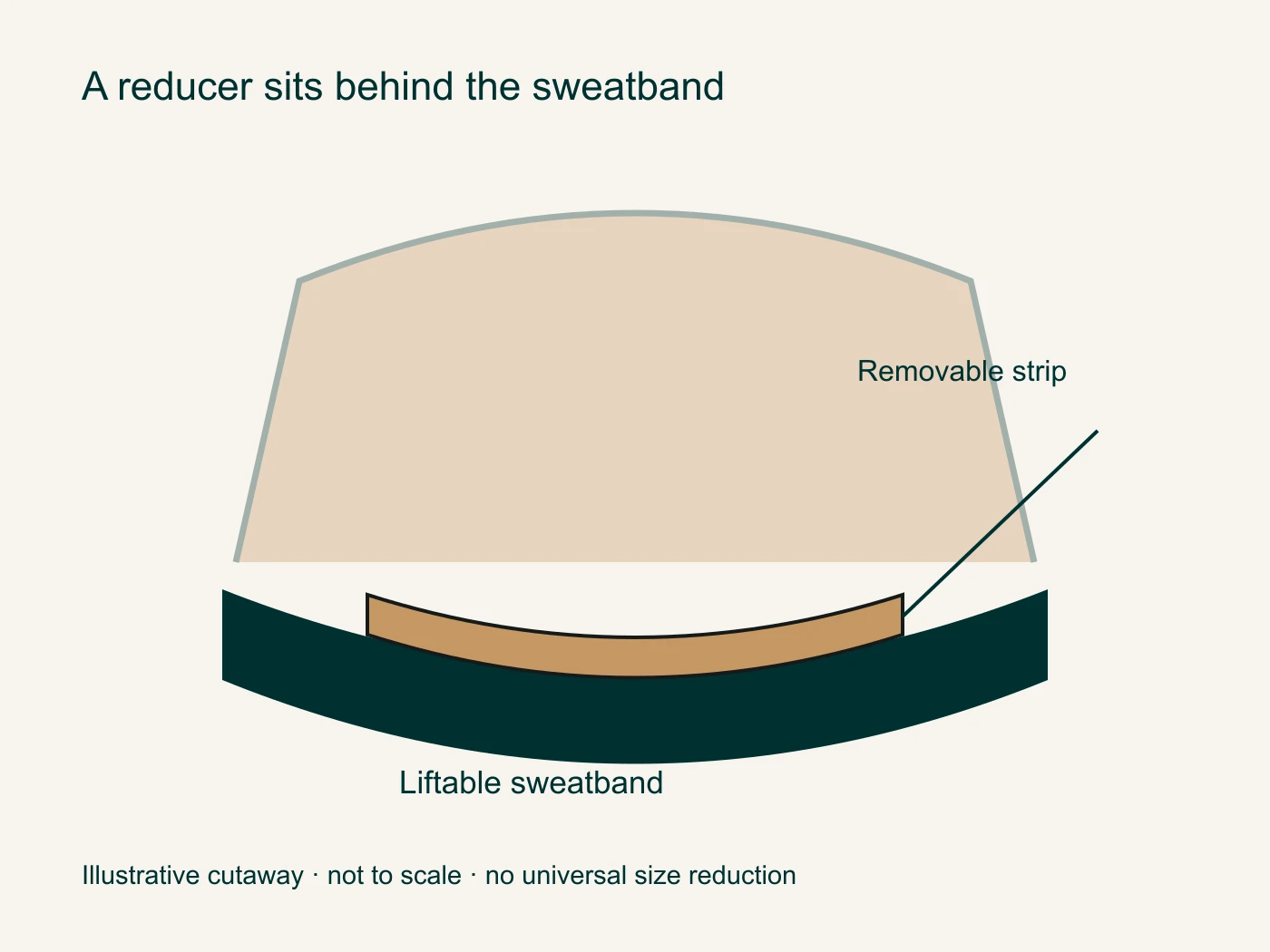
Hat fillers occupy some room behind the sweatband. They can be useful when the basic fit is good but the opening needs a little refinement.
Akubra’s filler instructions describe tucking strips beneath the internal band and testing the fit before using the adhesive. Follow the instructions for your hat and insert, especially if the sweatband is fixed or difficult to lift.
A sensible sequence is:
- Check that the hat is otherwise a good fit and that a reducer is suitable.
- Try a small amount of removable padding, positioned as directed.
- Put the hat back at its intended wearing position.
- Check both security and pressure again.
- Stop if the padding creates a new pressure point or makes the hat sit badly.
Do not assume a strip of a particular thickness removes one universal hat size. Placement, compression and the band’s construction change the result.
If you are still deciding whether to return the hat, check the return policy before attaching anything. Adhesive is a commitment; a test fitting should not have to be.
Know When to Change Models
The smaller hat pinches. The larger one is loose. Neither settles properly.
At that point, stop treating the label as the only variable.
A longer head in a rounder opening may encounter pressure front and back while leaving space at the sides. A rounder head in a narrower opening may experience the reverse. Those patterns are clues, not a diagnosis you can make from one red mark.
Our Head Shapes for Hats guide explains that distinction. If the problem is how high or low the hat sits, read about crown depth.
For persistent trouble, give a specialist seller your measurement, exact model and a description of the pressure or gaps. “Too tight” is vague. “Pressure at the temples, with room at the front” gives them something to work with.
A different model can be the right answer even when neither neighboring size in the first model works.
Questions About Between-Size Fit
Should I Add Extra Room to My Head Measurement?
Record your actual measurement and follow the maker’s instructions. Do not add an arbitrary allowance and then size up again. That can turn one small uncertainty into a much larger hat.
If a specific brand asks you to measure with an allowance, follow that method for that purchase.
Will a Tight Hat Loosen as I Wear It?
Do not count on it. Materials and construction behave differently, and an elastic band remaining under tension is not the same thing as a fixed-size hat becoming larger.
If the hat is persistently uncomfortable, reassess it while an exchange is still possible.
Can I Shrink the Larger Hat Instead?
A reducer or intended adjuster is a more controlled first option when appropriate. Heat, water and improvised shrinking can affect more than circumference. Do not experiment on a new hat you may need to return.
Ask the maker or a hatter about that specific hat before altering it.
Make the Smallest Adjustment That Solves the Problem
Measure accurately, use the exact chart and follow the maker’s between-size advice. Then judge what arrives on your head.
A slightly loose hat that otherwise sits beautifully is a candidate for a modest adjustment. A hat that pinches, perches or rocks needs another look at size, shape or crown.
You are choosing something to wear—not a fitting problem to maintain.