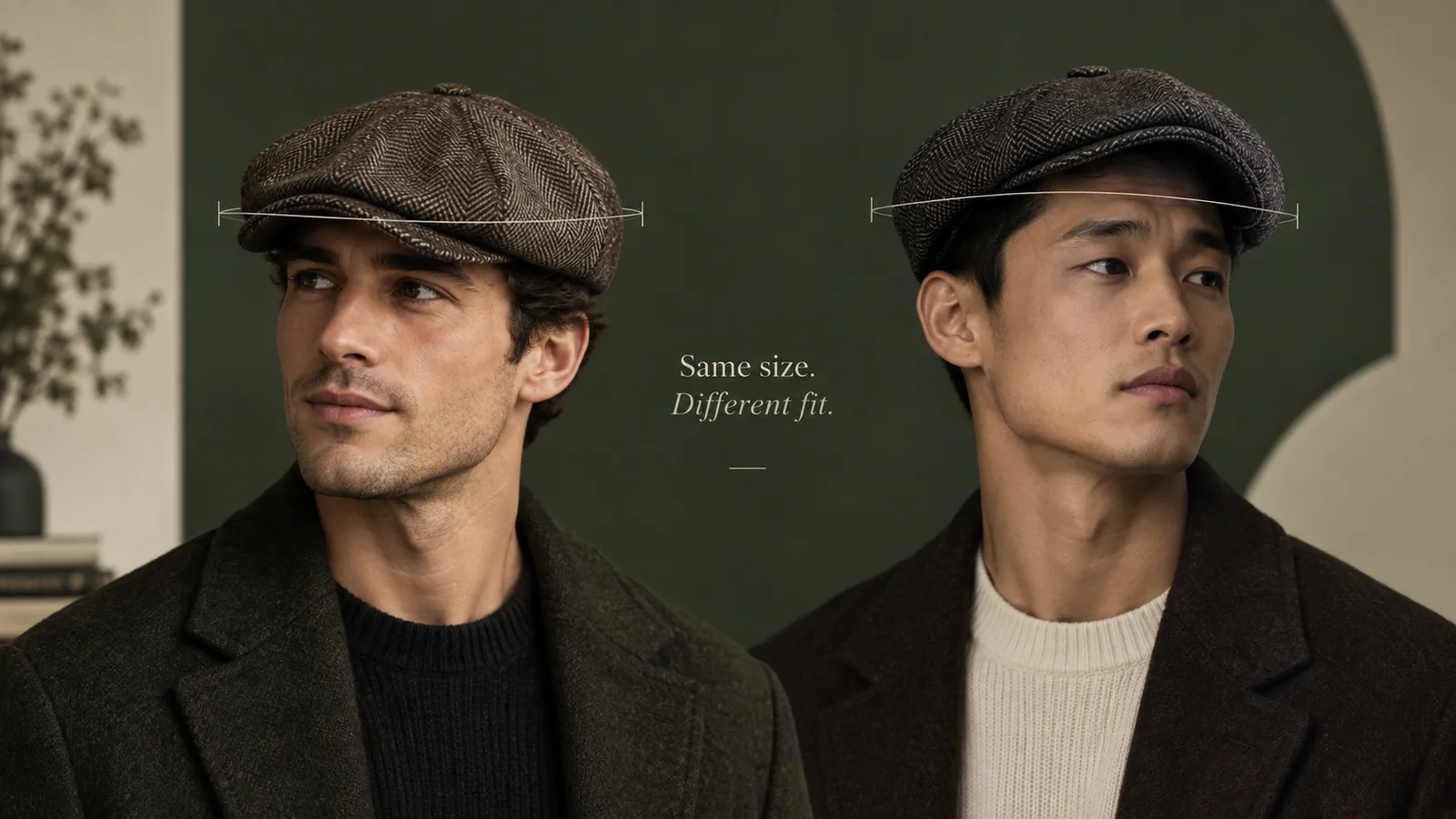
Why a Hat Can Be the Right Size but Still Fit Wrong
You measured carefully. You checked the brand’s chart. The number matches.
And the hat still feels wrong.
Maybe it pinches at the temples. Maybe it fits around your head but somehow sits too high. Maybe the front feels tight while there is obvious space at the sides. Or perhaps everything seems technically correct until you move and the hat starts rocking around.
That does not necessarily mean you measured badly or chose the wrong size.
Hat size is mostly about circumference. Fit is about what happens when that circumference meets the actual shape of your head and the actual shape of the hat.
Those are related. They are not the same thing.
Quick answer
A hat can be the correct size and still fit poorly because circumference is only one part of fit.
The same head measurement can behave differently depending on:
- your head shape;
- the shape of the hat opening;
- crown depth and profile;
- the hat’s construction and sweatband;
- the material and amount of give;
- your hair;
- where you actually intend to wear the hat.
That is why two hats carrying the same size label can feel surprisingly different.
If you have not measured yet, start with our How to Measure Your Head for a Hat guide. The rule is simple: measure where the hat’s sweatband will actually sit.
Once you have a repeatable measurement, the number gives you a starting point.
The rest is fit.
Size tells you circumference. It does not tell you shape
Imagine two heads with exactly the same circumference.
One is relatively round. The other is noticeably longer from front to back.
The tape can produce the same number around both heads, but those heads are not the same shape.
Hat makers know this. Some manufacturers describe particular hats by oval shape as well as size; Stetson, for example, identifies a number of western hats as Long Oval.
That distinction matters because the inside of a structured hat also has a shape.
A mismatch can produce a familiar pattern: pressure in one direction and spare room in another.
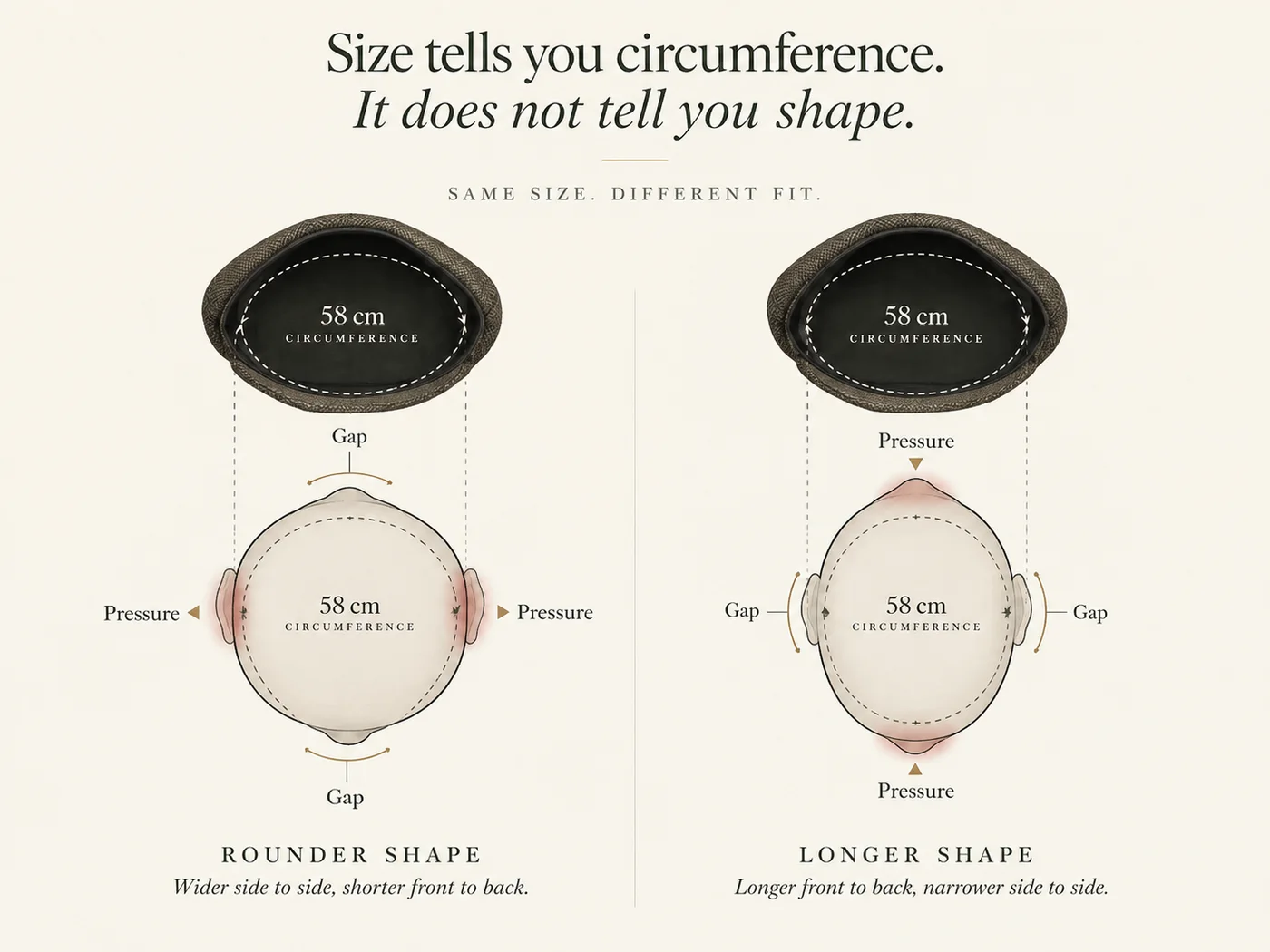
If the hat pinches at the sides but gaps front and back
The hat opening may be too long and narrow for a relatively rounder head.
Going up a size may reduce the pressure, but it can also create even more unused space elsewhere.
If it presses front and back but feels loose at the sides
You may have the opposite problem: a relatively longer head inside a rounder opening.
Again, the size number can be perfectly plausible while the geometry is wrong.
These are clues rather than a home diagnostic system. Heads are not perfect geometric shapes, hats vary by model, and soft hats behave differently from rigid ones.
The useful lesson is simpler:
Localized pressure plus looseness somewhere else is often a reason to question shape, not automatically size.
If that pattern sounds familiar, our Head Shapes for Hats guide goes deeper into what those differences can mean.
Crown depth can make a correct size sit wrong
Circumference answers what happens around your head.
It does not tell you what happens above it.
A crown that is too shallow for the way the hat is meant to sit can make a hat feel as though it is perched on top of your head even when the sweatband circumference is reasonable.
A deeper crown can sit lower.
That can be useful — until it is deeper than you want for your head, hairstyle or preferred wearing position.
This is one reason a hat can feel strangely small without actually being too small around the band.
Crown depth deserves to be treated as its own fit variable rather than as another name for hat size. We’ll cover it next in the NESH FIT series.
The same labelled size does not mean the same hat
This is one of the most irritating parts of buying hats online.
You can own a hat in one size, order another style in apparently the same size, and discover that the second one feels completely different.
That does not automatically mean one of the labels is wrong.
Different models can have different:
- opening shapes;
- crown depths;
- crown structures;
- sweatbands;
- linings;
- amounts of stretch;
- intended wearing positions.
Even within one manufacturer, hats can be built around different profiles. Stetson’s western range, for example, includes long-oval hats with different crown heights and shapes.
So your existing hat can be a useful reference.
It is not a universal size guarantee.
Structured hats expose fit problems faster
A soft knit cap has considerable freedom to adapt.
A structured fedora does not.
Neither does a fitted cap, stiff straw hat or firmly blocked western hat to the same degree.
The less a hat can adapt to your head, the more its own geometry matters.
Lock & Co., for example, describes professional fitting methods that record the actual shape of the head rather than relying on circumference alone. Depending on the hat, small fit adjustments may also be possible through sizing methods or professional fitting.
That does not mean a structured hat should hurt until it “breaks in.”
Persistent pressure is information.
What the pressure pattern can tell you
You do not need to turn hat fitting into skull geometry.
Pay attention to where the problem is.
| What you notice | What it may suggest |
|---|---|
| Tight all the way around | Size may be too small, or the sweatband is unusually firm |
| Pinches at the sides, loose front/back | Possible head/hat shape mismatch |
| Presses front/back, loose at the sides | Possible opposite shape mismatch |
| Circumference feels fine but hat rides high | Crown may be too shallow for the intended fit |
| Hat sits lower than you want | Crown depth, profile or wearing position may be involved |
| Hat rocks or shifts despite seeming large enough | Size, shape, crown or grip may be involved |
| Fine initially, uncomfortable after wearing it | Reassess the pressure rather than assuming it will simply break in |
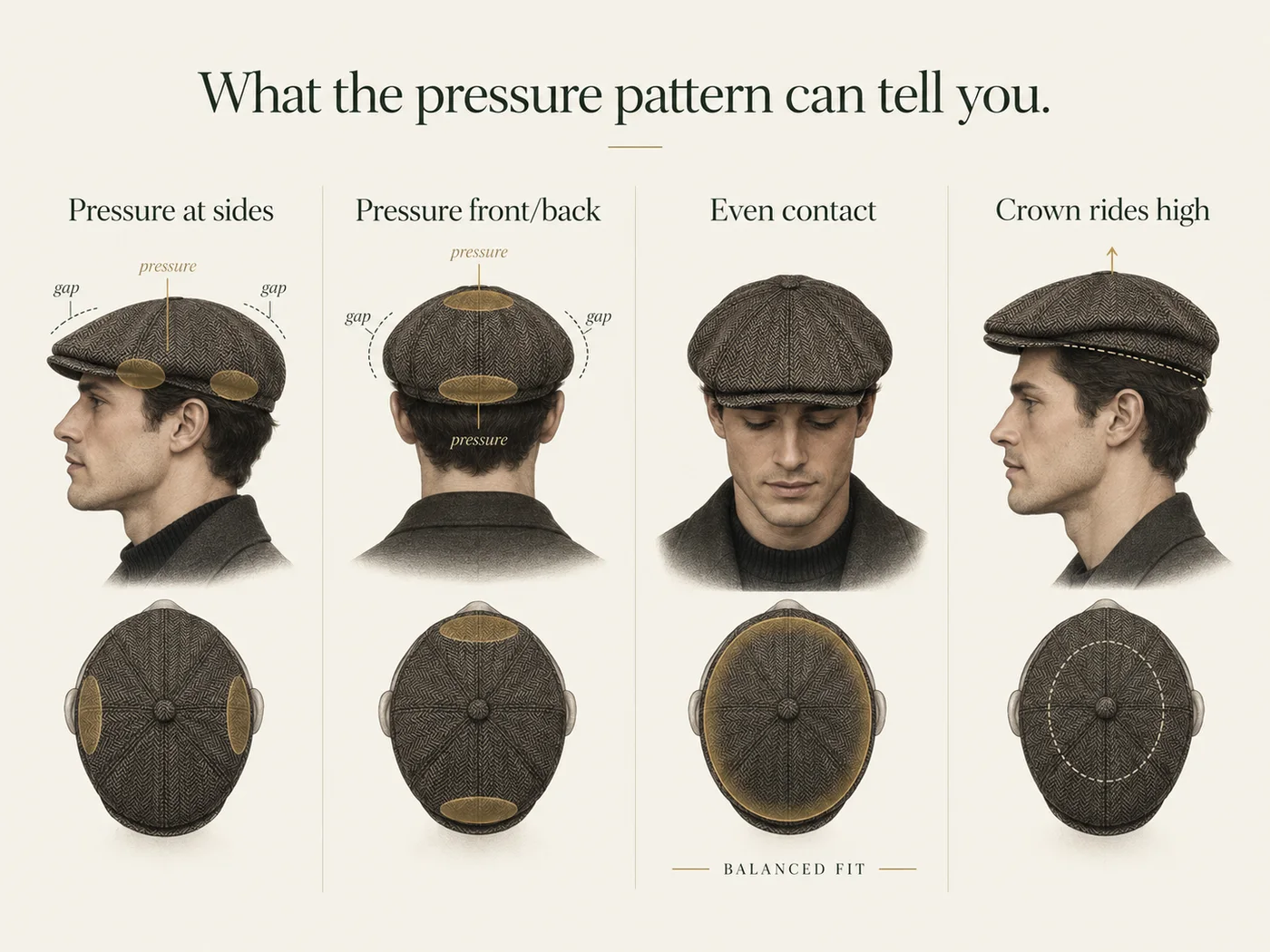
The word may matters here.
These patterns can help narrow the problem. They do not tell you with certainty what every hat is doing.
Don’t automatically solve uneven pressure by sizing up
If a hat is simply tight all the way around, the next size may well be the right answer.
But if it is pressing hard at the sides while already leaving space at the front and back, going larger can trade one problem for another.
The more useful question is:
Is the whole hat too tight, or is it tight in particular places?
Uniform tightness points more strongly toward size.
Uneven pressure deserves a closer look at shape and construction.
Hair can change the practical fit
Your measurement should reflect how you expect to wear the hat.
Thick hair, curls, braids, extensions or a major haircut can all change the amount of space needed inside it.
That does not mean adding an arbitrary amount to your measurement.
Measure consistently with the hairstyle you expect to wear most often.
And measure along the actual sweatband line.
What to do when the size is right but the fit isn’t
Before exchanging the hat for another size, run through this.
1. Confirm the measurement
Measure again from scratch rather than trying to reproduce the previous number.
Use the line where that particular hat’s sweatband is intended to sit.
If two measurements are close enough to lead to the same size decision, you have a useful baseline.
2. Check the specific manufacturer’s chart
Do not assume the same S, M, L or fractional size means exactly the same thing across brands.
Use the chart for the actual product or manufacturer when one is available.
3. Notice where the pressure is
“Too tight” is less useful than:
“Tight at both temples but loose at the front.”
That pattern tells you far more.
4. Look at how the crown sits
Does the hat settle onto your head naturally?
Does it stop high even though the band does not feel particularly tight?
Does it sit lower than you want?
Those clues point beyond circumference.
5. Try another model, not only another size
If the number seems right but the geometry does not, a different hat in the same size may be a better experiment than the same hat one size larger.
That is the part size charts cannot solve for you.
What a good fit should feel like
There is no universal amount of pressure that suits every hat.
But a wearable hat should generally feel secure without forcing you to tolerate persistent pinching or obvious pressure points.
Lock & Co. describes a good fedora fit as secure without being uncomfortably tight or pinching around the temples.
You should not have to spend the entire day thinking about the hat on your head.
And you should not need to convince yourself that obvious discomfort proves the size must be right because the chart said so.
The chart gets you into the fitting room.
It does not finish the fitting.
The useful way to think about hat fit
Start with circumference.
Then ask:
Does the shape match?
Does the crown sit properly?
Is the pressure reasonably even?
Does the hat stay where I intend to wear it?
If those answers are good, the size is probably doing its job.
If they are not, changing the number on the label may not solve the actual problem.
That is the difference between hat size and hat fit.
Where to go next
If you still need to translate your measurement into a size, use our Hat Size Guide.
If the number looks right but the hat pinches in particular places, read Head Shapes for Hats.
And if the circumference feels right but the hat seems to perch too high or sit differently from what you expected, the next part of the FIT series is Hat Crown Depth: Why It Matters for Fit.