NESH Fit Intelligence Methodology
NESH does not treat every product statement as the same kind of evidence. A claim moves from source fact to provenance, normalization, derivation, confidence and, only then, a qualified public output. No stage silently erases the one before it.
NESH has not physically tested every product. Manufacturer-published information remains distinct from information that NESH measured or tested directly. Affiliate status cannot change evidence confidence, fit conclusions or organic ranking.
The Short Version: How a Claim Reaches a NESH Page
The controlled sequence is:
SOURCE FACT → PROVENANCE → NORMALIZATION → DERIVATION → CONFIDENCE → PUBLIC OUTPUT
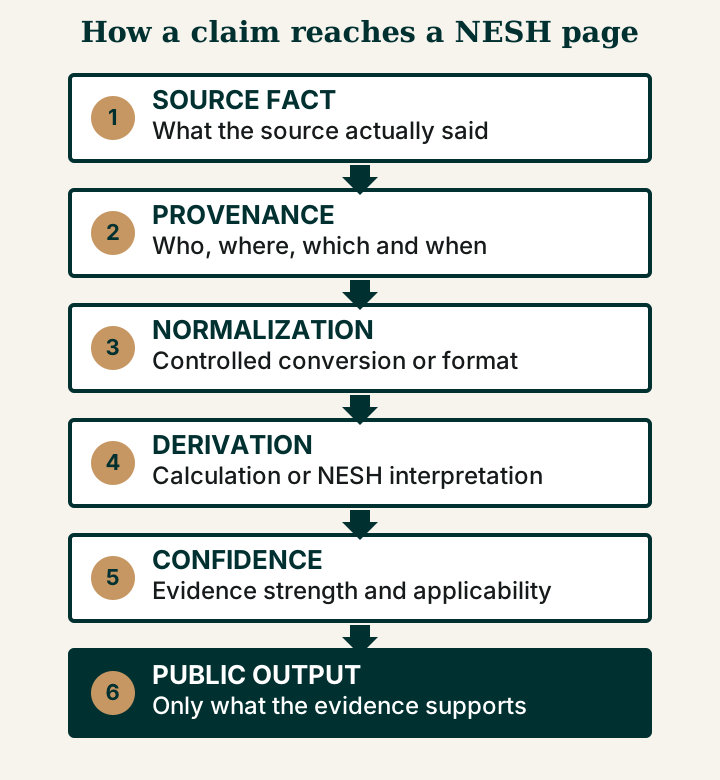
- Source fact: what the source actually said.
- Provenance: who published it, where it came from, which product, variant or region it applies to, and when NESH checked it.
- Normalization: a conversion or controlled format that makes comparison possible without removing the source representation.
- Derivation: a calculation or NESH interpretation kept distinct from the original fact.
- Confidence: a qualitative assessment of evidence strength, applicability, completeness and conflict.
- Public output: only the level of claim the evidence responsibly supports.
This chain lets a reader distinguish what was published by a source, what NESH transformed and what NESH interpreted. It does not mean every source becomes public, every step is automated or the process guarantees truth.
Where NESH Gets Hat Information
NESH considers direct measurement, manufacturer information, authorized-seller information, observations, and illustration as different evidence types. Source type matters, but so does direct applicability to the exact SKU, size, region, generation, and date; a higher category does not win automatically.
For example, a manufacturer may update a model after an older NESH measurement. A regional authorized distributor may document a local version that is absent from a global page. Repeated user or hatter observations may reveal a fit pattern before a manufacturer discusses it. Credible conflicts are preserved and reviewed rather than silently overwritten.
| Evidence label | What it means | Can support | Limitation |
|---|---|---|---|
| NESH measured/tested | NESH physically measured, photographed or tested the exact identified product, SKU and size under a documented method. | Direct claims within that method and scope. | It does not automatically apply to other sizes, variants, generations or conditions. |
| Manufacturer-published | Information captured from an official manufacturer page, chart or document. | Attributed official specifications and manufacturer claims. | It is not independent NESH physical testing. |
| Authorized seller/distributor | Attributed secondary product information from an authorized seller or distributor. | Useful product or specification evidence when manufacturer information is absent or incomplete. | Important fit claims generally deserve corroboration where possible. |
| Community/expert observation | An experienced hatter’s observation, user report, forum discussion or other qualitative observation. | Fit clues, hypotheses and recurring qualitative patterns. | It is not measured product fact without separate validation. |
| Illustrative/synthetic | Programmatic or AI-created material used to explain a concept. | Education or visualization. | It cannot prove a physical characteristic of a real commercial product. |
The labels protect several important boundaries. “NESH measured/tested” applies only to the exact item and question examined under a documented method. Manufacturer and authorized-seller information remains attributed to those sources rather than becoming independent NESH testing. Community or expert observations can reveal patterns, but one report is not a general product fact. Illustrations can explain a 7 cm brim; they cannot prove that a named product has one.
Source Facts, Normalized Values and NESH Interpretations
Keeping these layers separate prevents a conversion or inference from looking like a second independent source. NESH preserves the original representation alongside useful normalized and display forms.
A Conversion Example
- Source value: 2¾ in brim
- NESH normalized value: 6.985 cm
- Public display: 7.0 cm
The 2¾ in value remains the source representation. The 6.985 cm value is its conversion, and 7.0 cm is the rounded public display. The conversion is not another independent fact.
Illustrative methodology example — not a live product claim.
| Source | Checked date | Source value | NESH normalized value | Confidence | Limitation |
|---|---|---|---|---|---|
| Illustrative official product document | Example: 31 August 2026 | 2¾ in brim | 6.985 cm; displayed as 7.0 cm | High confidence | Demonstrates conversion only; it does not describe a real current product. |
The Hat Size Guide provides another practical example of exact conversion remaining distinct from approximate nominal size conventions.
What Counts as Derived Fit Intelligence
“Runs small,” “true to size” or “runs large,” head-shape tendency, long-oval or round-oval compatibility, crown-depth class, large-head suitability and between-size suitability may be NESH interpretations rather than source facts.
When NESH publishes an interpretation, readers should be able to see the evidence behind it, the method used, its confidence, and when it was last updated. One anecdote cannot establish that a model “runs small,” and NESH does not use a universal opaque Fit Score.
The How to Measure Your Head for a Hat shows how a source measurement begins, while Head Shapes for Hats explains self-observation and uncertainty.
What NESH Confidence Labels Mean
Confidence describes evidence—not product quality. NESH uses qualitative labels rather than a theatrical numeric score.
| Confidence | Plain-language meaning |
|---|---|
| Very high confidence | Direct NESH measurement or testing within its scope, or a strong official specification with no meaningful conflict. Very high does not mean infallible. |
| High confidence | Reliable manufacturer data or strongly corroborated high-quality evidence. |
| Medium confidence | Useful but incomplete retailer evidence, or repeated qualitative observations with a coherent pattern. |
| Low confidence | A single anecdote, ambiguous source, inferred relationship or unresolved contradiction. Low does not mean false. |
| Unknown | No usable evidence for the question. Unknown does not mean incompatible. |
What Happens When Data Is Missing or Sources Disagree
Missing is a valid state. Where useful, NESH distinguishes known, unknown or not published, not applicable, not yet researched, and conflicting or unresolved information. These states stop absence or ambiguity from turning into false certainty.
Unknown Is Not a Negative Result
“No head-shape evidence available” does not mean “not suitable for long-oval heads.” Missing or low-confidence information is not converted into a negative recommendation.
Conflicts Stay Visible Until Resolved
When credible sources disagree, NESH keeps the conflict visible until it can be explained or resolved. NESH:
- keeps both credible records;
- checks region, size, generation, variant and date;
- prefers the source most directly applicable to the exact item;
- marks unresolved disagreement;
- reduces confidence where necessary; and
- does not present disputed precision as settled fact.
A manufacturer and regional authorized distributor can both be credible while describing different variants. Checking applicability may explain the difference; if it does not, the disagreement remains visible.
Product Changes, Checked Dates and Volatile Commerce Data
The same marketing model name can survive changes to SKU, materials, construction, geometry, sizing or generation. Older evidence may still be correct historically. NESH prefers versioning and supersession over silently rewriting that history.
Different information ages at different rates:
- Stable: basic type, historical family and documented construction.
- Slow-changing: size charts, materials, geometry and specifications.
- Volatile: price, stock, merchant availability and available sizes or colors.
Slow-changing active-model information is generally rechecked roughly every 6–12 months or when change is detected. That is not one guaranteed schedule for every field. Volatile commerce information should carry a current timestamp when displayed; otherwise it may be suppressed or labeled stale. Prices and availability can change between checks, so readers should check the official product or merchant source before purchasing.
What “NESH Measured/Tested” Requires
NESH uses “NESH measured/tested” only when NESH physically measured, photographed or tested the exact identified product, SKU and size under a documented method. The label applies only to what that method examined.
NESH has not physically tested every product. Casual handling is not a formal test. Manufacturer measurements remain manufacturer measurements, retailer values remain retailer values, and AI imagery is never physical testing. Free or discounted samples require disclosure, but receiving one does not change the method or finding.
How Automation and Illustrative Content May Be Used
Automation may help extract approved source information, normalize units, validate and compare records, detect changes and flag contradictions. It may not invent measurements, promote weak evidence into strong evidence, silently resolve conflicts, fabricate testing or assign unsupported strong fit conclusions. NESH remains accountable for the public output.
Illustrative or synthetic content must remain labeled. It may explain proportion or process, but it cannot establish a physical fact about a named commercial product.
How Evidence Governs NESH Tools and Public Model Pages
Evidence requirements depend on what an output is being asked to do. The NESH Hat Size + Head Shape Profiler accepts circumference in centimeters or inches, normalizes it and accepts an optional self-observed head shape. It does not provide US/UK or universal S/M/L mappings, between-size recommendations, diagnosis, model compatibility, saved profiles, accounts or persistence.
The Large-Head Hat Fit Finder accepts circumferences from 40–80 cm. It uses current qualifying products with applicable NESH measured/tested or manufacturer-published sizing evidence, High or Very High confidence, no conflicting size/range evidence, and freshness and current-status controls. Results use exact published sizes or published fit ranges and present source, confidence and checked-date information. The tool does not guarantee comfort or total fit, and no results does not prove that no suitable hat exists.
NESH does not currently recommend models by head shape; that would require stronger model-specific evidence.
NESH may keep partial records internally without publishing them. A public model page needs enough verified context to be useful: confirmed identity, meaningful size or fit information, another relevant specification group, provenance, a checked date, and no critical unresolved identity conflict. A completeness percentage alone is not enough.
The Commercial Firewall
NESH keeps four layers separate: fit evidence, editorial recommendation, merchant availability and affiliate relationship.
Commission cannot improve evidence confidence, alter a fit conclusion or change organic ranking. A non-affiliate product can outrank an affiliate product, and NESH may link to a non-affiliate merchant when it is the better option for the reader. Paid placement, if ever used, must be separate and labeled. Free or discounted products and sponsorships must be disclosed, and sponsors cannot determine methodology or findings.
The Affiliate Disclosure explains these commercial relationships in more detail.
How to Read NESH Evidence Labels
Start with the evidence label: it tells you whether a statement came from direct NESH work, a manufacturer, an authorized seller, observation or illustration. Then read the confidence and checked date, and note the exact product, size, region or version covered. A limitation is part of the claim, not fine print.
Use the FIT hub for the wider system and the relevant article, tool, or model page for context. If a source is missing, old, or disputed, NESH labels that limitation instead of overstating the claim.