Head Shapes for Hats: Round Oval, Regular Oval and Long Oval
Head circumference and head shape describe different things. Circumference measures the distance around your head. Head shape describes how that circumference is distributed front-to-back and side-to-side. Two people can have the same circumference and still experience the same hat differently.
Round oval, regular oval and long oval are practical terms used in hat fitting. They can help describe a possible relationship between your head and a hat's internal opening, but they are not medical or anatomical diagnoses. A self-observed category also cannot guarantee compatibility with a particular model.
If you still need a circumference, start with How to Measure Your Head for a Hat. If you have the measurement but need to interpret centimeters, inches or common nominal sizes, use Hat Size Guide.
Why Circumference and Head Shape Are Different
Imagine two top-down outlines with the same distance around them. One can be more nearly round, while the other extends farther from front to back and is narrower from side to side. Their circumferences can match even though their proportions do not.
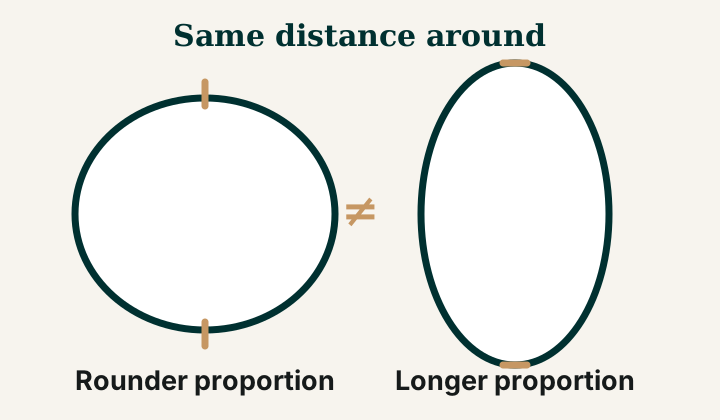
That difference matters because a hat has an internal opening with its own proportions. A hat can match your nominal circumference while pressing in some places and leaving space in others. The issue may involve the relationship between your shape and that opening rather than the size number alone.
Custom hatter Brent Black illustrates this with two people who both measure 23 inches: they need the same nominal size, but the longer-oval relationship calls for an opening that is longer front-to-back and narrower side-to-side. It is an example of the distinction, not a universal formula.
The Three Common Hat-Fitting Descriptions
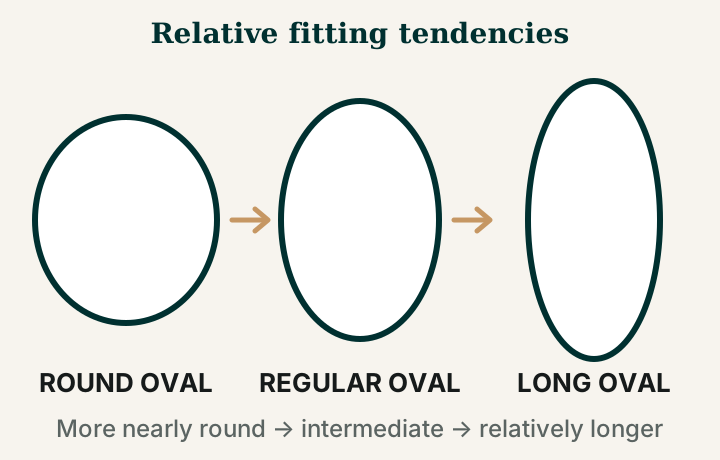
The categories below describe relative tendencies as viewed from above. Individual outlines vary. Any fit clue only tells you something about your relationship with that particular hat—it is not a universal label for your head.
| Category | General visual tendency | Possible fit clues | Limitations |
|---|---|---|---|
| Round oval | More nearly round in top view; not geometrically circular | A more elongated hat opening may create side or temple pressure with more room front and back | This pattern may have other causes and does not prove a round-oval category or model match |
| Regular oval | An intermediate oval relationship used as a default trade description in many systems | A compatible regular-oval opening may produce more even contact without pronounced localized gaps | “Regular” does not mean anatomically normal, ideal or universally compatible |
| Long oval | Relatively longer front-to-back and narrower side-to-side | In a regular-oval opening, front/back pressure with looser sides may be consistent with a longer-oval relationship | One symptom does not prove a category; the hat's size, stiffness and construction also matter |
| Other / mixed / not sure | Does not fit one simple schematic, combines tendencies or cannot be judged confidently | Contact may be uneven or inconsistent between hats, or no clear pattern may appear | This is a valid outcome; do not force a label or infer compatibility |
Round Oval
Round oval describes a proportion that is relatively more nearly round from above. It does not mean the outline is a perfect circle. The useful comparison is with the opening of the hat being tried.
If that opening is more elongated, you may notice contact or pressure at the sides or temples while there is more space at the front and back. Catalena Hatters uses similar top-down diagrams and fit observations. The sensation is only a clue: the hat could also be too small, too stiff or shaped differently from another hat with the same label.
Regular Oval
Regular oval is an intermediate or default trade description in many systems. Current Stetson product specifications, for example, label particular western models “Regular Oval.” That is a product-level shape description, not a universal definition of every regular-oval hat.
“Regular” does not mean normal, ideal or anatomically standard. It also does not guarantee even contact. The result still depends on the exact internal opening, construction and wearer.
Long Oval
Long oval describes a proportion that is relatively longer front-to-back and narrower side-to-side. In a regular-oval hat opening, pressure at the forehead and back with looser space at the sides may be consistent with that relationship.
Brent Black and Catalena Hatters describe this pattern in specialist fitting guidance. Treat it as a clue from the particular hat, then check the hat's size, material, and opening geometry before drawing a conclusion.
Other, Mixed or Not Sure
Real outlines do not have to match three clean drawings. Your shape may sit between categories, show asymmetry, vary in how you perceive it, or simply be difficult to judge. “Other / mixed” and “Not sure” are useful answers because they avoid forcing a precise answer where there isn't one.
Think of the category as useful language for describing fit—not a label you have to force yourself into. Your circumference remains useful even when you do not choose one.
Are Head-Shape Categories Standardized?
The reviewed hatters, manufacturers and block makers use oval terminology, but they do not establish one universal set of numeric thresholds. Names and systems vary. Maker-specific terminology varies. Brent Black uses ‘extra long oval’; Catalena Hatters includes ‘wide oval’; and Guy Morse-Brown uses broad and numbered oval conventions in its block system. These are source-specific fitting or block-making terms, not universal head-shape categories.
For example, Guy Morse-Brown Hat Blocks explains “Oval 36” as that block maker's convention for an oval that is 36 millimeters longer than it is wide. It describes a block in that system; it is not a universal threshold for assigning a person to a head-shape category.
NESH therefore does not calculate a shape from an aspect ratio or publish universal length-to-width cutoffs. A neat cutoff would make the system look more precise and standardized than it really is.
It also helps to separate three uses of “shape.” Hat-fitting head shape concerns the relationship at the opening. Face-shape advice concerns appearance and styling. Crown-shape names can describe the visible form of the hat. A cattleman or teardrop crown is not automatically a statement about its internal oval.
How to Make a Cautious Self-Observation
Self-observation can help you choose useful language, but it should remain tentative. Combine a top-down visual impression with contact clues from hats you already know. If the result is unclear, select “Other / mixed” or “Not sure.”
Compare a Top-Down View With Simple Outlines
A wall mirror and hand mirror can provide a top-down view for comparison with simple schematics. Look only for the broad relationship: more nearly round, intermediate or more elongated front-to-back.
Hair, viewing angle, lens perspective, posture and the exact position of the head can change what you see. The outlines are conceptual rather than calibrated anatomy. Do not assign a category because your view approximately resembles a single drawing.
A top-down photograph may be used as an optional private, local aid if it makes comparison easier. NESH does not need the image: do not upload it to the profiler, and do not treat a photograph as certain classification. Perspective and hair can distort a photograph just as they can distort a mirror view.
Treat Pressure and Gaps as Clues, Not Proof
Front/back pressure with looser sides may be consistent with a longer-oval relationship relative to that hat. Side or temple pressure with more room front/back may be consistent with a rounder or wider relationship. In both cases, the hat may instead be the wrong size, unusually stiff, shallow, softened by wear or built on a different opening geometry.
A pattern across several correctly sized, structured hats is more useful than one isolated experience, but compatibility still has to be established for the model itself.
When Professional Fitting Is Useful
A professional hatter can capture or compare the outline more directly through a traced form, conformateur or suitable hat-block comparison. Lock & Co. uses professional shape capture in bespoke top-hat fitting, and specialist block-making guidance describes matching an outline to band blocks.
These methods can provide stronger fit-specific information than casual observation, especially for a rigid, bespoke or repeatedly uncomfortable hat. They are still part of a hat-fitting workflow—not universal anatomical measurement standards.
What Pressure and Gaps May Suggest
Use contact patterns as a short decision sequence:
- Observation: Identify pressure, looseness or uneven contact in a particular hat.
- Possible interpretation: Consider whether the opening may be relatively rounder or longer than your self-observed tendency.
- Limitation: Check size, stiffness, material, crown depth, construction and prior wear before drawing a conclusion.
Pressure at the front and back plus space at the sides may point toward a longer relationship between the wearer and that opening. Pressure at the sides plus front/back room may point toward a rounder or wider relationship. Rocking, sitting high or uneven contact may involve shape, but those observations do not isolate one cause.
Why the Same Head Shape Can Fit Different Hats Differently
A self-observed category describes one part of the comparison. The hat supplies the other part. Its internal opening or sweatband geometry, construction, stiffness, material, crown depth, silhouette and adjustability can change how the same nominal size feels.
A soft material may adapt more than a rigid one. An adjustable closure can change usable circumference without fully resolving an oval mismatch. Two silhouettes from one manufacturer may not share identical opening geometry. That's why knowing your general head shape still doesn't automatically tell you which hat will fit.
Model compatibility requires model-specific evidence. If we don't have enough evidence for a particular model, we'll call the fit unknown rather than pretend we know. See NESH Fit Intelligence Methodology for how we decide what a source actually supports—and what we won't claim without enough evidence.
Continue Through NESH FIT
A useful sequence is:
MEASURE → CONVERT → SELF-OBSERVE SHAPE → CHECK MODEL EVIDENCE
Choose a tentative category—or “Other / mixed” or “Not sure”—in the NESH Hat Size + Head Shape Profiler and keep it alongside your head measurement. The profiler helps you record a self-observation; it does not diagnose head shape or recommend compatible models.
Use FIT hub to continue through the wider system. Keep your head measurement as the starting point, treat the shape label as a tentative observation, and tie any fit conclusion to evidence about the exact model or silhouette.